
Welcome to the Mathematical World!
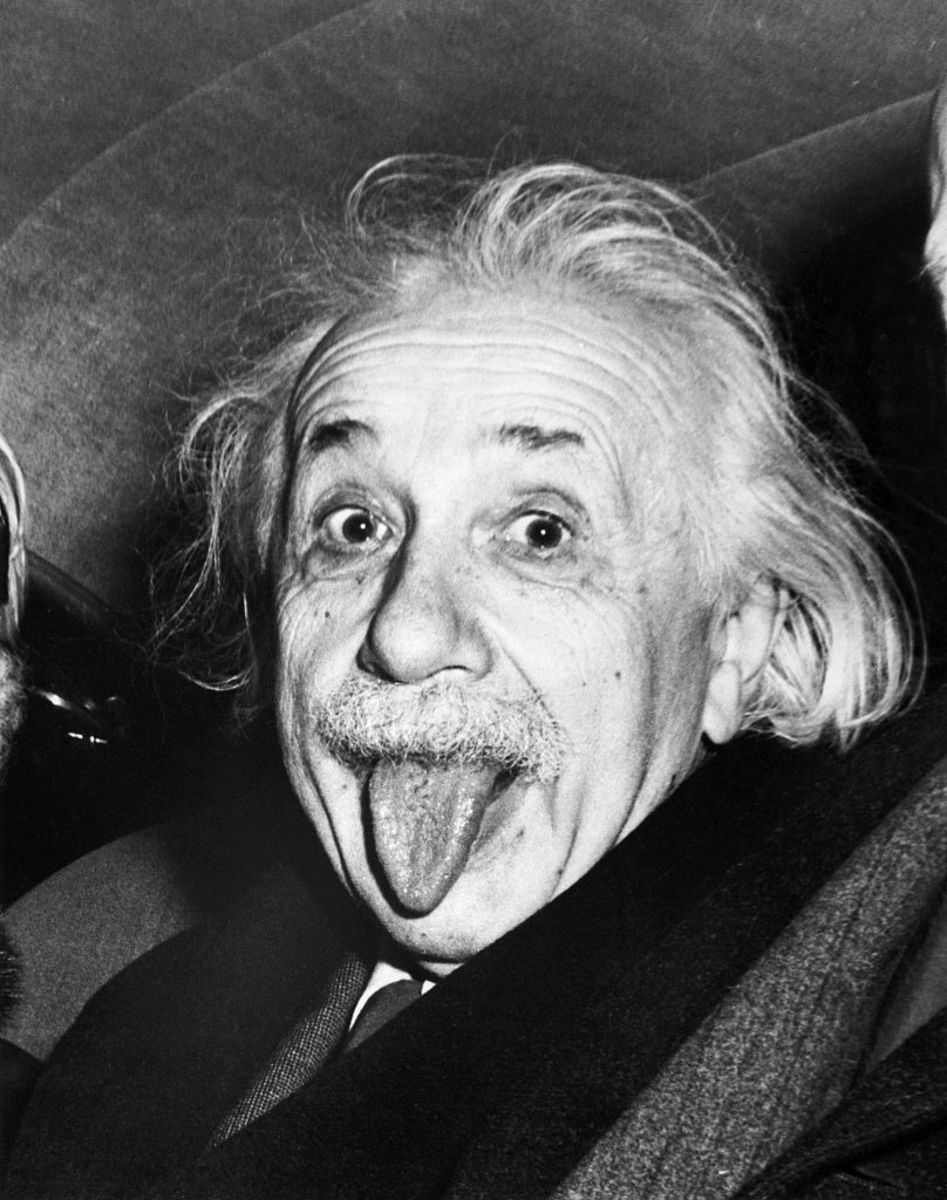
Albert Einstein
Father of Modern Physics
Albert Einstein (1879–1955) was a German-born theoretical physicist whose work revolutionized our understanding of space, time, and energy. Born in Ulm, Germany, Einstein showed exceptional aptitude in mathematics and physics from a young age. He later studied at the Swiss Federal Polytechnic in Zurich, where he developed the foundation for his groundbreaking theories.
Theory of Special Relativity
In 1905, Einstein published his theory of special relativity, introducing the concept that the laws of physics are the same in all inertial frames and that the speed of light in a vacuum is constant. This led to his famous equation:
\[ E = mc^2 \]which expresses the equivalence of mass (\( m \)) and energy (\( E \)), with \( c \) representing the speed of light.
Theory of General Relativity
Einstein extended his ideas to include gravity, formulating the theory of general relativity in 1915. He proposed that massive objects curve the fabric of spacetime, and this curvature affects the motion of other objects:
\[ R_{\mu\nu} - \frac{1}{2} R g_{\mu\nu} = \frac{8 \pi G}{c^4} T_{\mu\nu} \]Here, \( R_{\mu\nu} \) is the Ricci curvature tensor, \( R \) is the scalar curvature, \( g_{\mu\nu} \) is the metric tensor, \( T_{\mu\nu} \) is the stress-energy tensor, \( G \) is the gravitational constant, and \( c \) is the speed of light. This theory predicted phenomena such as the bending of light by gravity and the expansion of the universe.
Other Contributions
Einstein made numerous other contributions to physics, including:
- The photoelectric effect, explaining how light can eject electrons from a material, for which he received the Nobel Prize in Physics in 1921.
- Foundational work in quantum theory and statistical mechanics.
- Exploration of Brownian motion, providing evidence for the existence of atoms.
Legacy
Albert Einstein’s work transformed modern physics, laying the groundwork for quantum mechanics, cosmology, and modern technologies such as GPS, nuclear energy, and lasers. Beyond his scientific achievements, he was an advocate for civil rights, pacifism, and global cooperation. Einstein remains one of the most influential scientists in history, symbolizing human curiosity and intellectual brilliance.

All rights reserved by the Mathematical Unity
Contact: +8801400044645
Email: mathematicalhorse1453@gmail.com
Our Discord Server: Mathematical Unity [Ulus Riyadiyat]